



Cervicitis

Description of Medical Condition
Inflammation of the uterine cervix.
- Infectious cervicitis may be caused by Chlamydia trachomatis, Neisseria gonorrhoeae, Mycoplasma genitalium, ureaplasmas, herpes simplex virus, or Trichomonas vaginalis.
- Chronic cervicitis is characterized by inflammation of the cervix with no identified pathogen.
Cervicitis may be acute, with prominent infectious symptoms, or chronic, with persistent low-grade inflammation. In both situations, evaluation focuses on identifying sexually transmitted infections and ruling out more serious disease.
System(s) affected: Reproductive
Genetics: N/A
Incidence/Prevalence in the US:
- Gonorrhea: 166/100,000; 2% of sexually active women < age 30.
- Chlamydia: 290/100,000; 5-35% of women.
- Trichomonas: 1200/100,000; 5-25% of women.
Predominant age: Infectious cervicitis is most common in adolescents, but can occur in women of any age.
Predominant sex: Female only.
Anyone with a cervix may be affected, and clinicians consider sexual practices and exposure history when assessing risk.
Medical Symptoms and Signs of Disease
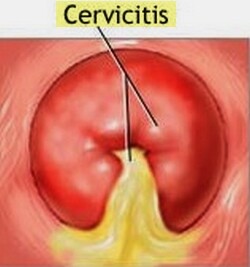
- Mucopurulent (yellow) discharge from the cervix.
- Cervical erosion or erythema.
- Easily induced endocervical mucosal bleeding.
- Cervical tenderness.
- Postcoital bleeding.
- Often asymptomatic.
Because many patients are asymptomatic, cervicitis is often identified during routine pelvic examination or sexually transmitted infection screening.
What Causes Disease?
- Chlamydia trachomatis.
- Neisseria gonorrhoeae.
- Herpes simplex virus.
- Trichomonas vaginalis.
- Mycoplasmas.
- Ureaplasmas.
- Cytomegalovirus.
- Unknown and other pathogens.
These infectious agents are usually sexually transmitted, and coinfection with more than one organism is common.
Risk Factors
- Multiple sexual partners.
- History of sexually transmitted disease.
- Postpartum period.
| Category | Examples | Clinical note |
|---|---|---|
| Sexually transmitted pathogens | C. trachomatis, N. gonorrhoeae, T. vaginalis, herpes simplex virus | Common infectious causes of cervicitis |
| Other infectious organisms | Mycoplasmas, ureaplasmas, cytomegalovirus | May act as additional or coexisting pathogens |
| Behavioural risk factors | Multiple partners, prior sexually transmitted disease | Increase exposure risk and likelihood of reinfection |
| Life stage factors | Adolescence, postpartum period, postmenopausal estrogen deficiency | May alter cervical susceptibility and local immunity |
Recognition of specific infectious causes and risk factors helps guide appropriate testing, counselling, and partner management.
Diagnosis of Disease
Diagnosis relies on a careful sexual history, pelvic examination, and targeted laboratory testing to identify infectious causes and exclude other conditions that can mimic cervicitis.
Differential Diagnosis
- Vaginal infections with Candida albicans or Trichomonas vaginalis extending onto the cervix.
- Carcinoma of the cervix.
Laboratory
- Endocervical gram stain; more than 10 white blood cells (WBCs) per high-power field (HPF) suggests cervicitis.
- Cervical cultures for C. trachomatis, N. gonorrhoeae.
- Polymerase chain reaction (PCR) and ligase chain reaction (LCR) are more sensitive than cultures for chlamydia. LCR can be used with urine.
- Enzyme immunoassays (EIAs) of endocervical swabs for chlamydia and gonorrhea.
- Nucleic acid amplification tests (NAATs) are more sensitive and can also be used on urine specimens.
- Wet mount for Trichomonas vaginalis.
- If ulcerations are present, culture for herpes simplex virus.
- Venereal Disease Research Laboratory (VDRL) or rapid plasma reagin (RPR) to rule out concurrent syphilis.
| Test | Primary target | Practical point |
|---|---|---|
| Endocervical gram stain | Inflammatory cells and gram-negative diplococci | More than 10 WBCs per HPF supports a diagnosis of cervicitis |
| Cervical cultures | C. trachomatis, N. gonorrhoeae | Traditional method; may be supplemented by molecular assays |
| NAATs, PCR, LCR | Chlamydia and gonorrhea | Higher sensitivity; can often be performed on urine specimens |
| Wet mount | T. vaginalis | Office-based test for motile trichomonads |
| HSV culture | Herpes simplex virus | Consider when ulcerations are present on the cervix |
| VDRL or RPR | Syphilis serology | Screens for concurrent syphilis in patients with cervicitis |
Drugs that may alter lab results: Recent antibiotic treatment.
Disorders that may alter lab results: N/A.
Pathological Findings
Inflammatory changes on Pap test.
Diagnostic Procedures
Colposcopy is indicated in chronic inflammation, with biopsy of suspicious areas.
Colposcopy may also be considered when bleeding persists, cytology is abnormal, or there is concern for neoplasia.
Treatment (Medical Therapy)
Appropriate Health Care
Outpatient treatment.
General Measures
Chronic cervicitis with negative cultures and biopsies may be treated with cryosurgery.
This procedure is generally reserved for persistent symptoms after infectious causes and malignancy have been excluded.
Activity
Full activity.
Patients are usually advised to avoid sexual intercourse until they and their partners have completed treatment and symptoms have resolved.
Diet
No special diet.
Patient Education
- Advise the patient to use condoms consistently.
- If the cause is infectious, advise the patient to inform her partners about their need for treatment.
Patients should be encouraged to return for follow-up if symptoms persist, recur, or new symptoms develop.

Medications (Drugs, Medicines)
Drug(s) of Choice
- If infectious cervicitis is suspected, treat without awaiting culture results. Ceftriaxone (Rocephin) 125 mg IM as a single dose, followed by either doxycycline (Vibramycin) 100 mg PO bid for 7 days or azithromycin (Zithromax) 1 g as a single dose.
- For trichomonas, metronidazole (Flagyl) 2 g as a single dose.
- For herpes, acyclovir (Zovirax) 200 mg PO 5 times daily (or 400 mg tid) for 7 days.
- Chronic cervicitis associated with postmenopausal vaginal atrophic changes may respond to topical estrogen creams.
Contraindications:
- Doxycycline should not be used in pregnant or nursing mothers.
Precautions: Doxycycline should not be taken with milk, antacids, or iron-containing preparations.
Significant possible interactions: Doxycycline with warfarin (Coumadin) and oral contraceptives may reduce the effectiveness of these medications.
Alternative Drugs
- Any of the following can be substituted for ceftriaxone (quinolones should not be used for gonorrhea in patients who have travelled to Hawaii, California, or Southeast Asia because of high levels of resistance)
- Ofloxacin (Floxin) 400 mg PO as a single dose.
- Ciprofloxacin (Cipro) 500 mg PO as a single dose.
- Levofloxacin (Levaquin) 250 mg as a single dose.
- Erythromycin base or stearate 500 mg PO qid, or erythromycin ethylsuccinate 800 mg PO qid, can be substituted for doxycycline.
Patient Monitoring
- Repeat cultures after treatment for chlamydia or gonorrhea are indicated in pregnant or high-risk patients.
- Annual Pap tests in sexually active patients screen for chronic cervicitis.
Monitoring symptom resolution and adherence to therapy is important to reduce the risk of reinfection and complications.
Prevention / Avoidance
Patients with more than one sexual partner should be advised to use condoms at every encounter.
Regular screening for sexually transmitted infections, timely treatment of partners, and counselling about safer sex practices can help prevent cervicitis.
Possible Complications
- Cervicitis with C. trachomatis or N. gonorrhoeae is associated with an 8-10% risk of subsequent pelvic inflammatory disease.
- Moderate to severe inflammation is associated with condyloma acuminatum and cervical carcinoma.
Expected Course / Prognosis
- Infectious cervicitis usually responds to systemic antibiotics.
- Chronic cervicitis may be resistant to treatment and should be monitored closely for cervical dysplasia.
Early diagnosis, appropriate antibiotic therapy, and consistent follow-up improve outcomes and help limit long-term sequelae.
Miscellaneous
Associated Conditions
Patients with infectious cervicitis should be screened for other sexually transmitted diseases, syphilis, trichomonas, and possibly human immunodeficiency virus (HIV).
Age-Related Factors
Pediatric: Infectious cervicitis in children should prompt investigation for possible sexual abuse.
Geriatric:
- Chronic cervicitis in postmenopausal women may be related to lack of estrogen.
- The possibility of infectious cervicitis should not be overlooked, as many geriatric patients remain sexually active.
Evaluation in older adults should consider both infectious causes and noninfectious factors such as estrogen deficiency.
Others: Adolescents remain a high-risk group for sexually transmitted diseases.
Pregnancy
Screen all pregnant women for infectious cervicitis because of the risk of transmission to the fetus.
Timely diagnosis and treatment help reduce complications for both parent and newborn.
Synonyms
Mucopurulent cervicitis.
International Classification of Diseases
616.0 Cervicitis and endocervicitis; 098.15 Acute gonococcal cervicitis; 079.88 Chlamydia infection; 099.53 Other venereal diseases due to Chlamydia trachomatis, lower genitourinary sites.