



Dermatophytes

Essentials of Diagnosis
- Characteristic pattern of inflammation on glabrous skin surfaces. The active border of infection is scaly, red, and slightly elevated.
- Wet mount preparation with potassium hydroxide (10-20%). Skin scraping from the active border shows branching, translucent, rod-shaped filaments (hyphae) in keratinized material under low-power microscopy (10-40x). The hyphae are uniformly wide and regularly septated.
- Wood's light examination (UV light at 365 nm) shows blue-green fluorescence with Microsporum canis and Microsporum audouinii. Trichophyton schoenleinii fluoresces pale green, and tinea versicolor shows white-yellow fluorescence.
- Culture should be performed using hair, nail, and skin specimens from particularly inflammatory lesions to make a definitive mycologic diagnosis.
General Considerations
Dermatophytes are moulds that infect keratinized tissues, including skin, hair, and nails. Although 40 dermatophyte species are known to infect humans, only about 15 are common causes of disease. These organisms belong to three genera: Microsporum, Trichophyton, and Epidermophyton. Because these fungi have similar infectivity, morphology, and pathogenicity, they are often categorized according to the clinical syndrome and preferred anatomic site with which they are associated, such as tinea capitis, tinea pedis, etc. "Tinea" comes from the Latin word meaning worm or moth. These superficial mycoses often create serpiginous skin markings.
Although tinea versicolor (caused by Malassezia furfur or Pityrosporum spp.) is not formally considered a dermatophytosis, it is also discussed in this chapter, because it also affects superficial skin layers.
Epidemiology
Dermatophytes are found in three distinct environmental niches and display specific adaptation to these sites: animals, humans, and soil. Therefore, they are classified as anthropophilic, zoophilic, or geophilic organisms. As these names imply, infection occurs following exposure to infected humans, animals (such as cats, dogs, or cattle), or soil.
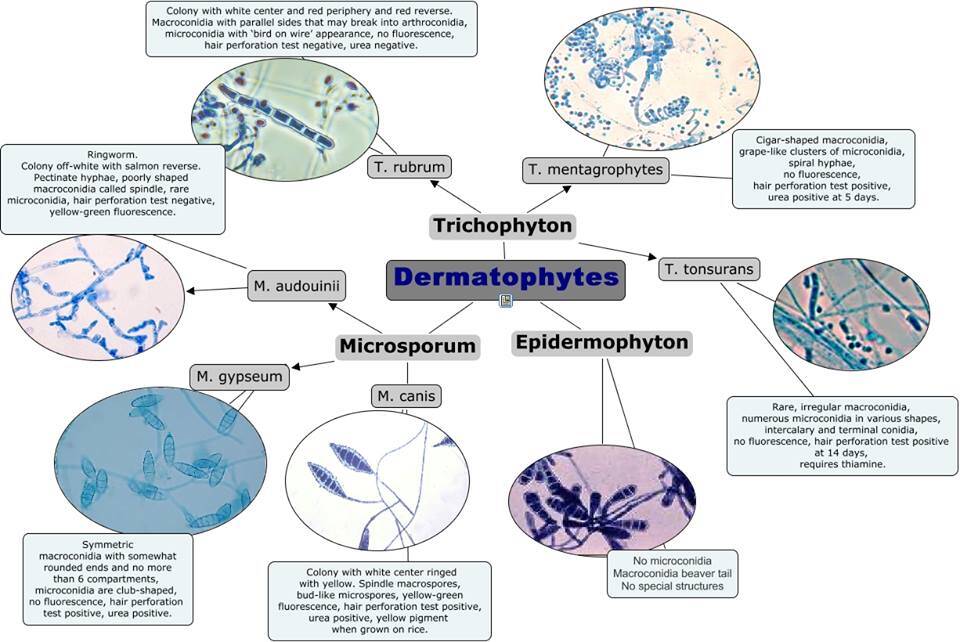
Dermatophytoses occur worldwide and vary in presentation according to the site of infection. Improved living standards in the United States since the end of World War II have decreased the incidence of tinea capitis. In contrast, dramatic increases in the incidence of tinea pedis and tinea cruris due to Trichophyton rubrum, an anthropophilic dermatophyte, have been observed in recent years in developed nations. T rubrum is the most common dermatophyte pathogen worldwide, affecting up to one-third of the population of industrialized countries. Tinea pedis occurs almost exclusively among people who wear shoes, because shoes provide warmth and moisture, which are conditions preferred by the causative organisms.
Transmission of zoophilic dermatophytes occurs through direct contact with infected animals or fomites, including troughs and stalls used by infected animals. Geophilic dermatophyte infections occur through direct contact with soil and are seen in greenhouse workers, but infections with these organisms are relatively less common than those caused by anthropophilic dermatophytes.
Microbiology
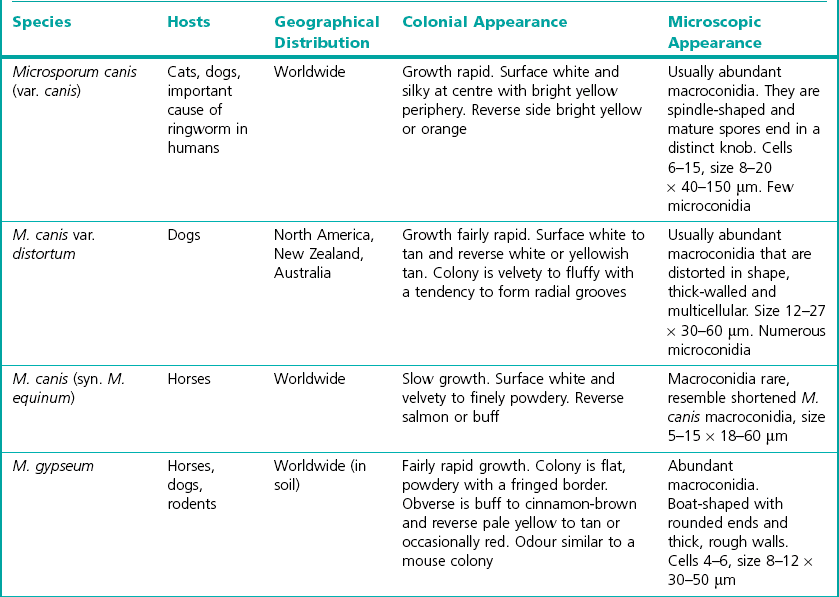
The dermatophytes belong to three anamorphic (asexual or imperfect) genera, Epidermophyton, Microsporum, and Trichophyton, of the Deuteromycota (Fungi Imperfecti). Members of the Epidermophyton genus have macroconidia that are smooth-walled and either single or in clusters, but these fungi have no microconidia. Members of the Microsporum genus have macroconidia with fusiform or cylindrical, roughened walls. They have fewer microconidia, which are found singly along the hyphae as pear-shaped structures. Trichophyton species have macroconidia with smooth, cylindrical walls. Their microconidia are numerous and spherical or pear-shaped, and they appear in clusters along the hyphae.
Conidia are used as the basis for dermatophyte speciation. Because dermatophytes form only hyphae and arthrospores in the nonviable keratinized tissue of infected humans, they must be cultivated in the laboratory to develop conidia for identification. Colonies form at room temperature on Sabouraud's agar, and their colour, texture, and morphology are also useful for species identification.
Pathogenesis
Host factors that enhance the development of dermatophytoses include genetic susceptibility markers, abraded skin, occlusive clothing, footwear, or dressings, and the presence of other cutaneous diseases such as atopic dermatitis. The dermatophytes invade the keratinized layers of skin by producing keratinases, which are enzymes that digest keratin. While adhering to and invading host skin, dermatophytes elicit a diverse set of clinical responses. Most lesions are contained within a given anatomic boundary and may even be self-limited, but widespread dermatophyte infection has been observed in patients with AIDS, patients receiving immunosuppressive drug regimens, and those with endocrinopathies such as Cushing's disease. The pathogenic features of superficial dermatophyte infections of the skin are broad and depend on both the fungus and the host response.
Trichophyton is also the name of a crude extract from certain dermatophytes that produces a tuberculin-like response in most adults. Two moieties of the galactomannan peptide are responsible for the antigenic response. The carbohydrate portion is responsible for an immediate response, and the peptide portion is associated with a delayed response and likely with immunity as well. Resistance to infection is T cell mediated and may be acquired after infection, but it varies in duration and degree depending on host factors, fungal species, and the site of infection.
Clinical Findings
The superficial mycoses are named according to the site of infection, which usually corresponds to the site of local inoculation. The degree of inflammation is often dictated by the nature of the environment from which the fungus originates. For example, anthropophilic dermatophytes elicit a milder immune response in humans than zoophilic fungi. The anthropophilic M audouinii causes minimal inflammation compared with the zoophilic M canis. Table 1 lists the microbiological differential diagnosis for each clinical syndrome discussed below.
Tinea Capitis
Tinea capitis, or scalp ringworm, mainly affects prepubertal children aged 4-14. It is most commonly observed in crowded living conditions and in areas of poverty. Infection of the hair shaft distinguishes this disease from other dermatophytoses that involve glabrous skin. Tinea capitis is often classified according to one of three patterns of fungal invasion noted microscopically: endothrix, ectothrix, or favus. Endothrix infections invade the inside of the hair shaft, and the cuticle is not destroyed; therefore, the scalp appears clinically as simple scaling. It may resemble seborrheic dermatitis or dandruff. Grey patches of alopecia may occur with minimal or no inflammation, or "black dot" alopecia may develop when hairs break off at the roots.
Ectothrix infections present with grey or scaling patches of alopecia with minimal or no inflammation. A "black dot" appearance may also be seen. Kerions and prominent inflammatory lesions may occur, because the dermatophytes that cause ectothrix infections invade both the inside and the outside of the hair shaft and follicles. Kerions are boggy, suppurative, and usually painful. Kerions are most commonly seen with M canis and rarely with Trichophyton mentagrophytes or Trichophyton verrucosum.
Favus infection leads to crusting and matted hair on the scalp with such severe invasion that permanent alopecia often results. It is primarily seen in Eastern Europe and Africa.
Tinea Barbae
Tinea barbae, like tinea capitis, affects the hair follicles and shafts, but it occurs in the facial area. It is often diagnosed only after it fails to respond to several courses of antibacterial agents. Affected hairs are easily removed, unlike those in bacterial folliculitis, which resist removal. The zoophilic dermatophytes T mentagrophytes and T verrucosum are the most common causes of tinea barbae. The condition often begins with a small cluster of follicular pustules and then develops into a boggy, erythematous, tumour-like abscess.
Tinea Corporis
Tinea corporis, or ringworm, refers primarily to lesions affecting nonhairy, glabrous skin, but it may also result from extension of scalp or groin infections. Lesions are usually sharply demarcated and ring-like with a raised border. Infections can range from mildly to highly inflammatory, with pustules, vesicles, and marked erythema. As the active border progresses, the central area may become brown or hypopigmented and less scaly.
Tinea Cruris
Tinea cruris, or jock itch, is more common in men and may involve the perineum and the perianal and thigh areas, but it rarely affects the scrotum. (In contrast, Candida infections typically involve the scrotum.) Tinea cruris typically presents as bilateral, asymmetric erythematous plaques that spread distally from the groin. Central clearing is common, along with an active erythematous border that may have vesicles or papules. Pruritus and burning are common complaints.
This infection is usually transmitted from the patient's foot to the groin. Tinea cruris often occurs in summer months after sweating or wearing wet clothing, or in winter months after wearing multiple layers of clothing, which leads to the warm, moist conditions that promote fungal growth.
Tinea Pedis
Tinea pedis, also known as athlete's foot, is the most common dermatophyte infection diagnosed overall and is usually caused by the anthropophilic organism T rubrum. Occlusive footwear promotes warmth and sweating, which provide an ideal environment for fungal growth. Tinea pedis presents in four general patterns: (a) interdigital infection with erythema, maceration, and scale formation; (b) "moccasin foot" with erythema and thick hyperkeratotic scales; (c) inflammatory infection with vesicles, usually on the medial foot; and (d) a less common ulcerative infection affecting the web spaces of the toes, sometimes superinfected with bacteria and often seen in immunocompromised patients. If tinea unguium is present, tinea pedis may persist because of constant reinfection from the nails.
Tinea Unguium
Tinea unguium, or onychomycosis, is an infection of the fingernails or toenails. Infections typically begin along the leading edge of the nail or the lateral border and involve the nail plate, resulting in opaque, chalky, or yellow nail discoloration. The nail may also become thickened and brittle. Inflammatory changes of the skin around the nail, including paronychia, are not seen with tinea unguium. Toenails are more frequently involved than fingernails, and the incidence increases with age.
Nondermatophytic moulds such as Scopulariopsis and Scytalidium spp., Acremonium, Fusarium, and Candida spp. cause ~ 5% of fungal nail diseases. This prevalence varies by geography, and these moulds may account for up to 50% of fungal nail infections in Southeast Asia. It is important to distinguish these fungi, because not all respond to the same therapy.
Tinea Incognito
Tinea incognito refers to dermatophyte infections that are disguised, often because they are treated with topical steroids and then lose some of their characteristic clinical features. Steroids may temporarily reduce inflammation, but the fungus can continue to grow because the immune response is impaired. The rash changes so that scaling margins disappear, borders become irregular, and a once localized process may expand. The diagnosis is easily made once steroids are stopped for a few days, scaling reappears, and hyphae can be seen on microscopy. Tinea incognito is most often observed in the groin, face, and hands.
Dermatophytid
Dermatophytid, or the "id" reaction, is an allergic response to tinea processes that causes sterile dermatitis at distant sites. The most common presentation is a patient with tinea pedis who develops itching and burning on the hands, usually on the sides of the fingers near the crease. Vesicles may appear and enlarge to bullae. Desquamation of the palms and soles occurs less commonly and occurs without inflammation. The lesions persist until the primary process resolves.
Tinea Versicolor
Tinea versicolor is a common fungal infection of the superficial skin layer caused by members of the Malassezia genus, especially Malassezia furfur, formerly known as both Pityrosporum orbiculare and Pityrosporum ovale. These organisms are lipophilic and use medium-chain-length fatty acids. They are part of the normal skin flora, but certain conditions promote proliferation, including excess heat, humidity, pregnancy, oral contraceptives, malnutrition, burns, Cushing's disease, corticosteroid therapy, or other forms of immunosuppression.
Clinically, tinea versicolor has a characteristic distribution and lesion pattern. It begins as small circular macules of various colours (hence the name "versicolor"), such as white, pink, or brown, and then expands radially. The varied colour of this rash stems from the host's pathologic response. For example, reddish macules or patches are related to a hyperemic inflammatory response. Hypopigmented lesions are caused by alterations in melanosome formation and transfer of pigment to keratinocytes. Tan or dark macules or patches are also related to alterations in melanosome formation. Each individual has uniform lesion colour. The upper trunk is the most commonly affected area, because the organism is found in highest numbers in areas of increased sebaceous activity. Lesions often become more apparent in summer, when hypopigmented areas contrast more sharply with unaffected tanned skin. Lesions are usually asymptomatic, but they may itch if inflammation is present.
Diagnosis
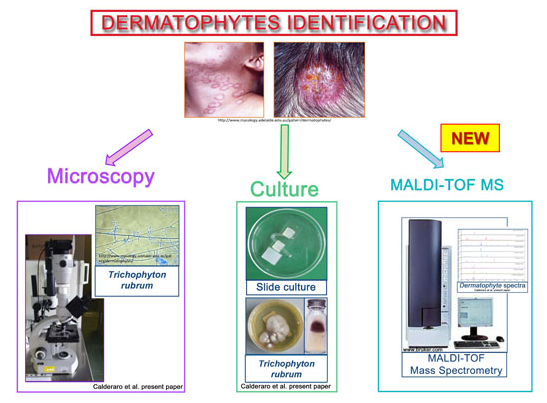
In addition to clinical recognition and diagnosis on clinical grounds, three specific techniques are useful for the workup and more definitive diagnosis of superficial mycoses: UV light examination, direct microscopy, and culture. Direct examination of the patient's skin in a darkened room using UV light (a Wood's lamp) is useful only for infections, primarily tinea capitis or corporis, caused by certain species including M audouinii, M canis, and T schoenleinii. These infections emit a blue-green colour.
Specimens for diagnosis by microscopy or culture can be collected using a razor or scalpel to scrape keratinized or flaking material from the leading edge of the newest lesion. Nail scrapings are ideal when the nail is scraped underneath the nail plate, first to clean it and then to collect a specimen onto a microscope slide or to inoculate culture. A few drops of 10-20% KOH solution are placed on the slide to dissolve keratin. Heating accelerates the process. This allows visualization of hyphae seen with dermatophytes, or hyphae and spores seen in candidal infections and tinea versicolor.
Because KOH wet mounts cannot differentiate among dermatophyte species, organisms should be cultivated to reveal the distinguishing forms of conidia. From a clinical perspective, it is usually not necessary to identify the dermatophyte species, because topical and oral agents are active against all of them. Species identification is important for scalp infections, severe or inflammatory skin infections, and certain nail infections, because systemic treatment is required for scalp infections, treatment may be prolonged and expensive, and species identification may help prevent zoophilic infections. Some nail infections may be caused by a mould (eg, Scopulariopsis spp.) that is grossly indistinguishable from dermatophytosis but will not respond to the same therapy. Culture is usually performed using Sabouraud's agar slants, which are incubated at room temperature for 1-3 weeks. The specific dermatophyte is then identified based on colony colour and texture, as well as light microscopy findings that reveal specific morphologic patterns.
Diagnosis of tinea versicolor is made by Wood's light examination, which shows irregular whitish-yellow areas of fluorescence, although some lesions do not fluoresce. Potassium hydroxide wet mount preparations show short, broad hyphae and clusters of budding cells, which are often described as having the appearance of "spaghetti and meatballs." Cultivation is possible but is rarely indicated and requires the addition of oil to the fungal culture media because the organism is lipophilic.
| Tinea type | Common dermatophytes | Typical clinical presentation | Key differential diagnoses | Diagnostic tools |
|---|---|---|---|---|
| Tinea capitis (ringworm of the scalp) | T tonsurans¹ T mentagrophytes² T violaceum¹ M canis² M audouinii¹ M gypsum³ |
Circular bald patches, short hair stubs, pruritic, advancing red border | Alopecia areata, psoriasis, seborrheic dermatitis, bacterial infections | UV light for M canis and M audouinii KOH mount of hair follicles and scrapings Cultures |
| Tinea barbae (ringworm of the facial hair) | T verrucosum² T mentagrophytes² |
Inflammatory lesions, follicular pustules, pruritic | Folliculitis, pyoderma | KOH mounts of exfoliated skin Cultures |
| Tinea corporis (ringworm of the smooth nonhairy skin) | T rubrum¹ T mentagrophytes² M canis² |
Circular scaly patches, advancing red borders, pruritic | Eczema, psoriasis, pityriasis rosea, erythema annulare centrifugum, subacute cutaneous lupus, drug allergy | KOH mount of skin scraping from leading edge Culture if indicated |
| Tinea cruris (ringworm of the groin) | T rubrum¹ T mentagrophytes² E floccosum¹ |
Well-demarcated, scaling circinate lesions with erythematous raised borders; scrotum is rarely involved | Cutaneous Candida, erythrasma, eczematous dermatitis, psoriasis | Vesicle from eczematous lesion: KOH and culture if indicated |
| Tinea pedis (ringworm of the feet) | T rubrum¹ T mentagrophytes² E floccosum¹ |
Interdigital: erythema, maceration, and scale Moccasin foot: erythema, thick hyperkeratotic scales Inflammatory: vesicles on medial foot Ulcerative: especially in web spaces with secondary bacterial infection |
Other fungi (Scytalidium hyalinum or Scytalidium dimidiatum), erythrasma, candidiasis, psoriasis, dyshidrosis | KOH mount of skin scraping from leading edge Culture if indicated |
| Tinea unguium (onychomycosis) | T rubrum¹ T mentagrophytes² Other nondermatophytes |
Small yellow spot begins at nail base; nail becomes brittle, friable, thickened | Nail bed tumours, yellow-nail syndrome, pachyonychia congenita, traumatic onychodystrophy | KOH mount of nail shaving or nail bed detritus Culture if indicated |
| Tinea versicolor | Pityrosporum ovale P orbiculare (Malassezia furfur) Not formally a dermatophyte |
Multiple small circular macules (white, pink, or brown) that enlarge radially; usually asymptomatic; may itch | Vitiligo, pityriasis alba, seborrheic dermatitis, secondary syphilis, pityriasis rosea | KOH mount of skin scraping Wood's light: irregular pale yellow-white fluorescence (some lesions do not fluoresce) |
| Fungal "id" reaction | Not a dermatophyte at the local site but associated with certain tinea infestations | Adults: vesicular eruption of the palms Children: erythematous lichenoid papules |
Adults: associated with tinea pedis Children: associated with kerions of the scalp |
Look for and diagnose the primary offending dermatophyte |
¹ Anthropophilic. ² Zoophilic. ³ Geophilic.
Treatment
The principles of treatment are outlined below according to the specific clinical presentation. Most tinea infections involving the skin can be treated with topical agents such as an imidazole twice daily for 2 or 3 weeks. Terbinafine is also available in both topical and oral formulations and appears to be more potent, requiring shorter courses with longer-lasting clinical responses. Terbinafine and newer related drugs block ergosterol synthesis at an earlier step than azole drugs.
If the infection is widespread, involves a large surface area, or is particularly inflammatory, systemic drugs are indicated. For infections of the hair and nails, debridement is important before systemic treatment. Several oral medications, including itraconazole, fluconazole, and terbinafine, can be dosed daily or in so-called "pulsed" regimens for effective treatment of infections of keratinized tissues. The concept underlying pulse dosing takes advantage of drug deposition in the nail so that the total dose can be reduced. Elevated amounts of drug are given repeatedly for short intervals that correspond to the time required for a finger or toenail to grow. For example, a slightly higher daily dose is given for 1 week each month for the estimated duration required for the infected nail to regrow.
Treatment of tinea versicolor involves a 2.5% selenium sulfide suspension applied to the entire skin surface from the lower posterior scalp area down to the thighs for 10 minutes each day for 7 days. Another common regimen is to apply the lotion and wash it off after 24 hours, repeating once weekly for a month. Antifungal creams are useful. Single-dose oral treatment with ketoconazole, itraconazole, or fluconazole has also been shown to be effective. Other important adjunctive measures to minimize reinfection include discarding or boiling frequently worn garments that are in contact with the skin. Lesions may take months to clear, because they result from depigmentation that can persist despite eradication of the fungus.
| Tinea type | First-choice therapy | Second-choice therapy | Adjunctive measures and notes |
|---|---|---|---|
| Tinea capitis | Terbinafine 250 mg orally per day (during 2-3 weeks for T tonsurans; during 4-8 weeks for M canis) Pediatric considerations: safe |
Griseofulvin, 500 mg orally per day (adults during 4-6 weeks; children, 10-20 mg/kg/day during 6-8 weeks) | Selenium sulfide shampoo may hasten eradication of the organism For highly inflamed kerions, a short course of prednisone should be considered Antibiotics as indicated |
| Tinea barbae | Same systemic regimens as for tinea capitis | Same alternatives as for tinea capitis | Antibiotics (eg, dicloxacillin) for bacterial superinfection Avoid shaving during active infection |
| Tinea corporis | Cream preparations (applied twice daily for 2-3 weeks and continued 1 week beyond resolution): terbinafine, miconazole, clotrimazole, or ciclopiroxolamine Pediatric considerations: these topical agents are safe in children with twice-daily dosing |
Terbinafine 250 mg orally once per day during 2-3 weeks | If highly inflammatory zoophilic infection, extended oral therapy may be indicated For highly inflamed kerions, a short course of prednisone should be considered |
| Tinea cruris or tinea pedis | Topical therapy as for tinea corporis | Undecylenic acid, tolnaftate, or haloprogin topical cream twice per day for 2-3 weeks | Avoid tight clothing Avoid occlusive shoes Dry feet thoroughly |
| Tinea versicolor | Selenium sulfide lotion 2.5% applied from base of scalp to knees for 10 minutes each day for 7 days (topical treatment used for limited disease; recurrence rates can be high) Pediatric considerations: selenium sulfide lotion is safe with the same application schedule |
Itraconazole 200 mg orally once daily for 5-7 days Ketoconazole 400 mg orally as a single dose or 200 mg orally for 7 days Fluconazole 400 mg orally as a single dose (repeat in 1 week) |
Hot laundering of clothing may reduce recurrence rate |
| Tinea unguium (onychomycosis) | Terbinafine 250 mg orally daily during 6 weeks for fingers and during 12 weeks for toes OR pulse dosing: 500 mg daily during 1 week/month for 4 months for toes and 2 months for fingers Pediatric considerations: safe in children |
Fluconazole 150-300 mg orally each week during 3-6 months for fingers or during 6-12 months for toes Itraconazole 200 mg orally four times per day during 3 months for toes Pulse dosing: 200 mg orally twice daily during 1 week per month during 2 months for fingers |
Keep nails short and clean, clipped straight Use cotton gloves for dry manual work and vinyl gloves for wet work Change instruments between care of normal and infected nails Use antifungal foot and shoe powder |
Prevention and Control
Several interventions have been shown to be useful for the prevention and control of dermatophytes, depending on their type and anatomic location. In general, keeping the body surface clean and dry; avoiding occlusive gloves or shoes that may promote tinea unguium, manus, or pedis; and avoiding sweat-dampened clothing that enables tinea versicolor to thrive can all help control infection. Regular cleaning of showers and changing areas at public pools with bleach is thought to control some infections, as is individual use of chemicals such as foot powders.
Prevention and control of dermatophytoses
Prophylactic measures
- Identify and avoid exposure to animals or fomites suspected of harbouring dermatophytes.
- Boil or wash clothing using a commercial facility.
- Disinfect public showers and bathing areas.
Isolation precautions
- None.