



Echinococcal Infection

Essentials of Diagnosis
- Radiographic evidence of a cyst.
- Positive echinococcal serology.
- Cyst aspiration showing hydatid sand or hooks.
- Typical histologic appearance of the cyst wall.
General Considerations
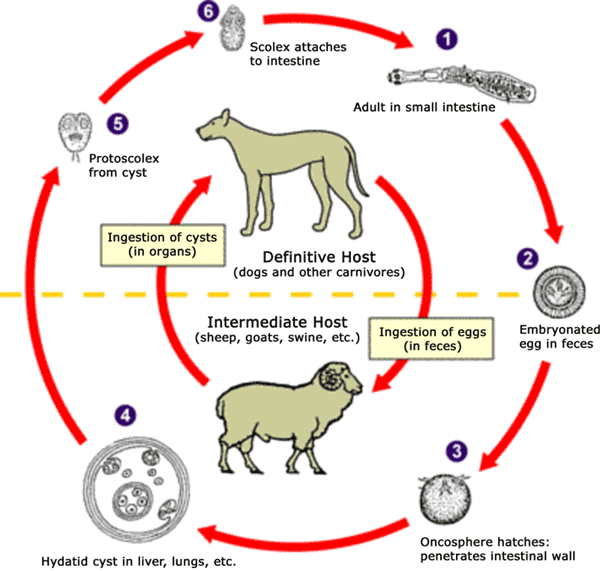
The normal life cycle of Echinococcus species does not involve humans. Human disease occurs when a person becomes an accidental intermediate host for the parasite; tissue invasion is followed by cyst formation (hydatid cysts). The definitive hosts for echinococcal species are canines (usually dogs), in which the adult worms live. There may be several hundred worms within a host, and the worms are small, usually 3-6 mm long.
The scolex attaches to the dog's intestine, and each scolex has a single proglottid. As the proglottids mature into gravid proglottids containing multiple eggs, they detach and are passed in the stool. The eggs are resistant to desiccation and may remain viable for weeks. Eggs are ingested by intermediate hosts, most commonly sheep and cattle but occasionally humans. The eggs hatch in the duodenum, and the larval forms penetrate the intestinal mucosa and disseminate through the bloodstream to distant sites, most commonly the liver. Within tissues, the larva develops an encasing cyst composed of an outer layer and an inner fluid-filled layer. Within 1 year, cysts may reach 5-10 cm in diameter.
Inside the inner layer, daughter cysts form; they may detach and float within the fluid, and daughter scolices may develop. Ingestion of meat containing hydatid cysts leads to infection of definitive hosts, and adult worms develop. Infection with Echinococcus granulosus causes unilocular cysts. In contrast, infection with Echinococcus multilocularis is associated with multilocular cysts. E multilocularis also differs from E granulosus in that definitive hosts include foxes, wolves, cats, and dogs, and intermediate hosts include small rodents. Endemic areas for E granulosus include Africa, the Middle East, southern Europe, Latin America, and the southwestern United States. For E multilocularis, forested areas of Europe, Asia, and North America are endemic.
Clinical Findings
Signs and Symptoms
In humans, the presentation of infection depends on the location of the hydatid cyst. The principal locations for cysts in humans include the liver (60%), lung (20%), muscle (4%), kidney (4%), spleen (3%), soft tissues (3%), brain (3%), bone (2%), and other sites (1%). In the liver, cysts may be diagnosed incidentally or may present with pain or a visible mass. Pulmonary cysts are usually asymptomatic, but sufficiently large cysts may cause cough, dyspnea, or pleuritic pain.
Hydatid cysts in the brain are rare but potentially the most serious. They may cause obstructive hydrocephalus with ataxia and dementia, or mass effect with seizures, headache, or focal neurologic deficits. Bony hydatid cysts most commonly involve the vertebrae and present with bone pain. Other presentations include soft tissue swelling and bone pain, or pathologic fractures secondary to cyst-related weakening of cortical bone. In about 20% of infected patients, cysts are multiple; all patients with suspected disease require a thorough evaluation.
| Site | Approximate frequency in humans | Typical manifestations |
|---|---|---|
| Liver | ≈ 60% | Incidental finding, right upper quadrant pain, palpable mass, signs of biliary or portal involvement in advanced disease |
| Lung | ≈ 20% | Often asymptomatic; cough, dyspnea, pleuritic chest pain with larger cysts or mass effect |
| Muscle / soft tissue | ≈ 6-7% combined | Localized swelling or mass, sometimes discomfort; may be detected on imaging or incidentally |
| Kidney / spleen | Each ≈ 3-4% | Flank or abdominal pain, mass effect, or incidental finding on imaging |
| Brain | ≈ 3% | Headache, seizures, focal neurologic deficits, signs of raised intracranial pressure or obstructive hydrocephalus |
| Bone | ≈ 2% | Persistent bone pain, pathologic fractures, vertebral involvement with possible neurologic compromise |
| Other sites | ≈ 1% | Organ-specific symptoms depending on location; may mimic neoplastic lesions |
Laboratory Findings
Eosinophilia may be present in about 25% of patients, but it is a non-specific marker. Serologic testing is available using a variety of techniques; if results are positive, they provide supportive evidence of echinococcal infection. However, a negative serologic test result does not rule out hydatid cyst disease. More recent serologic techniques may help differentiate E granulosus infection from E multilocularis infection. Some serologic assays show cross-reaction between cysticercosis and hydatid cyst disease. Another potential diagnostic procedure is cyst aspiration, although it poses some risk of anaphylaxis (see Complications). This test can be useful for diagnosing E granulosus hydatid cysts. A small volume of fluid is removed and examined microscopically for hydatid sand (daughter cysts and scolices). If a cyst is old, sand may not be present; in that case, a centrifuged specimen should be examined for hooks.
Imaging
Radiographically, cysts appear either as unilocular cysts with an air-fluid level (E granulosus) or as multiloculated cysts with little or no fluid (E multilocularis).
Differential Diagnosis
Hydatid cysts usually present as liver pain or a liver mass, a lung mass with irritative obstructive symptoms, or seizures with focal neurologic symptoms. The main differential diagnosis is primary or metastatic malignancy of the involved organ. With a unilocular hydatid cyst, the radiographic appearance is often sufficient to exclude malignancy. In contrast, multilocular cysts caused by E multilocularis are slow-growing, often have little or no fluid, and frequently show central necrosis, which can suggest malignancy. Therefore, biopsy and histologic examination are necessary to definitively differentiate multilocular cysts from malignancy.
Complications
Hydatid cysts may occasionally leak fluid into the host's systemic circulation, which can sensitize the host. Subsequent leaks may induce an allergic response or even anaphylaxis. In addition, release of cyst tissue may be associated with embolization and the development of additional cysts at distant sites. Cysts may also become secondarily infected, producing abscesses. Mechanical complications of cysts are also possible, most commonly leading to portal hypertension, ascites, and portosystemic shunting.
Treatment
Treatment of hydatid cysts caused by E granulosus combines surgical and pharmacological interventions. Solitary unilocular cysts at operable sites are generally treated with surgical excision, percutaneous drainage, or both. Extreme care is required to avoid spillage of cyst contents and subsequent seeding at other sites. One approach involves removing a portion of cyst fluid and instilling a cystocidal agent, such as 95% ethanol, before removing the entire cyst. Some authorities also recommend preoperative and postoperative therapy with albendazole or mebendazole.
Recent experience with albendazole suggests it is a promising alternative. Mebendazole is an alternative therapy but may be less effective than albendazole. Complicated or multiloculated cysts (caused by E multilocularis) require surgery, often in association with albendazole as described above. An experimental approach for inoperable cysts involves oral therapy with albendazole or mebendazole combined with percutaneous aspiration and instillation of 95% ethanol. Although the approach is promising, it has not been validated in large trials, and treatment should be guided by specialized expertise.
Prognosis
The prognosis of hydatid disease is variable. Early diagnosis and treatment of simple unilocular cysts is associated with an excellent outlook. In contrast, advanced multilocular disease at multiple sites with advanced portal hypertension is potentially lethal. Medical therapy for inoperable E granulosus cysts is associated with cure in 30% of cases and improvement in 50%. Inoperable E multilocularis infection is associated with a 10-year mortality rate of 90%. Some authorities recommend indefinite treatment with albendazole or mebendazole in such cases.
Prevention & Control
In areas that are endemic for hydatid disease, transmission commonly occurs incidentally during activities such as camping and picking berries. Education is the best preventive measure for transmission in these settings. Routine screening of household pets and appropriate treatment of animals found to carry Echinococcus spp. is another important control measure. Pet owners should be educated about good hygiene practices to prevent accidental ingestion of eggs from dog stool. Finally, carcasses of infected hosts must be disposed of in ways that prevent transmission to canines.