



Taenia saginata Infection

Essentials of Diagnosis
- Stool examination reveals spheroidal yellow-brown eggs (31-43 µm).
- Motile proglottids that appear singly in stool.
- Mature proglottids are square.
- The scolex has no hooklets and has four suckers.
- Gravid proglottids have 15-20 lateral branches.
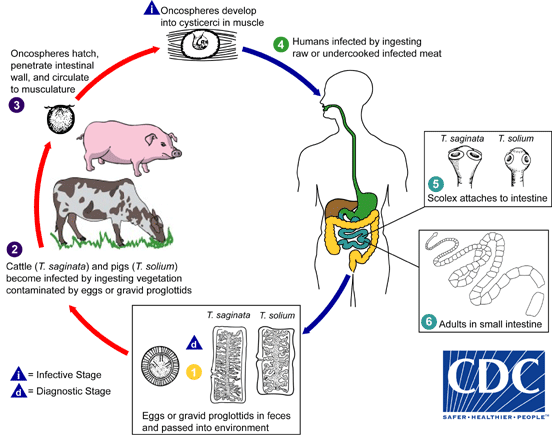
General Considerations
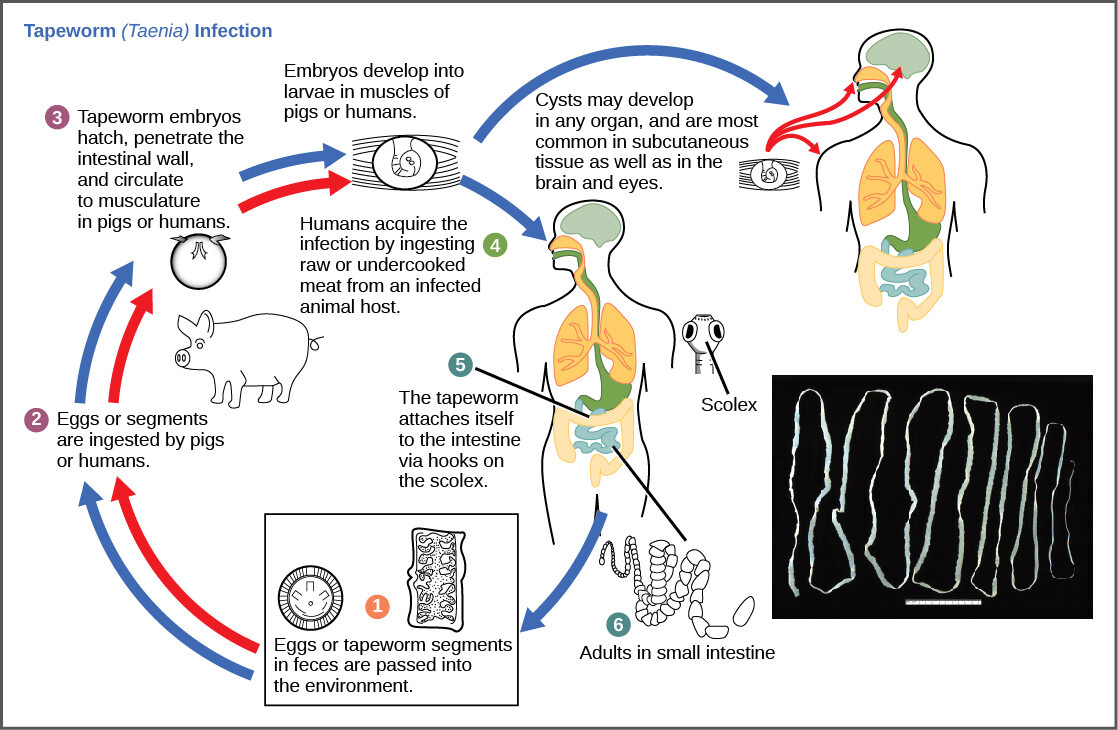
T saginata infection is commonly associated with ingestion of undercooked beef. It is distinguished from T solium infection because human infection with the larval form (as in cysticercosis) is extremely rare with T saginata. T saginata infection is common in regions with intensive cattle breeding, such as central Asia and central and eastern Africa. Alternative intermediate hosts for T saginata include llamas, buffalo, and giraffes. The life cycle of T saginata is similar to that of T solium: larvae are ingested in infected meat, and the tapeworm attaches to the intestinal epithelium and matures in 12 weeks. Mature tapeworms produce gravid proglottids with the characteristic 15-20 lateral branches; these segments contain numerous eggs. When cows ingest eggs or proglottids, the eggs hatch and larvae migrate into striated muscle. Case reports describe T saginata cysticercosis in humans, although the incidence is exceedingly uncommon.
| Feature | Findings in T saginata | Notes on differentiation |
|---|---|---|
| Eggs | Spheroidal, yellow-brown, 31-43 µm, seen on stool examination | Supports a diagnosis of Taenia tapeworm infection when found with compatible proglottids. |
| Proglottids in stool | Motile, often appearing singly; mature proglottids are square | Patients may notice moving segments on stool or clothing and seek care. |
| Scolex | No hooklets and four suckers | Helps distinguish T saginata from T solium when the scolex is recovered and examined. |
| Gravid proglottids | 15-20 lateral branches | T solium typically has 7-13 lateral branches; if branch counts cannot be assessed, the species may remain uncertain. |
| Larval disease | Human cysticercosis is exceedingly rare | Clinically important because concern for cysticercosis is far greater with T solium infection. |
Clinical Findings
Signs and Symptoms
T saginata infection is most often asymptomatic, although a minority of patients may report nonspecific abdominal cramps or malaise. The proglottids of T saginata are motile, and patients may report seeing moving segments in the stool.
Because symptoms are often mild or absent, recognition of infection often depends on patients noticing segments and bringing them to clinical attention.
Laboratory Findings
Blood examination in patients with T saginata infection typically reveals no abnormalities, although mild leukocytosis with eosinophilia may be present. Otherwise, all laboratory tests except microscopic stool examination are normal. Stool examination often reveals eggs and proglottids. The main basis for differentiating T saginata from T solium is the gravid proglottid: for T solium it has 7-13 lateral branches on each side of the uterus, whereas T saginata has 15-20 lateral branches.
Differential Diagnosis
T saginata infection is usually not associated with clinical symptoms. Patients most often seek medical attention after finding T saginata proglottids in stool or on clothing. The main differential diagnosis is distinguishing T saginata proglottids from T solium proglottids. If gravid proglottids are not present, differentiation may not be possible; in that case, patients should be treated as though they have T solium infection.
Complications
Usually, no complications are associated with T saginata; however, regurgitation and aspiration of proglottids may occur.
Treatment
Treatment of T saginata infection is similar to treatment of intestinal T solium infection and typically consists of a single dose of either praziquantel or niclosamide. Follow-up stool examinations should be performed 1 month after treatment.
Because species differentiation may be difficult when gravid proglottids are not available, many clinicians choose regimens that are effective against both Taenia species and confirm clearance with repeat stool studies.
Prognosis
The prognosis for patients with intestinal T saginata infection is excellent.
Prevention & Control
Prevention of T saginata infection involves thoroughly cooking beef and beef products to a core temperature of at least 65°C (149°F). Beef should also be inspected for cysts, and infected carcasses destroyed.
Public health control measures that improve meat inspection and educate consumers about safe cooking practices can markedly reduce transmission, especially in regions where cattle breeding is intensive.
| Measure | Target | Practical examples |
|---|---|---|
| Thorough cooking of beef | Larval stages in meat | Cook steaks, roasts, and ground beef so that the core reaches at least 65°C (149°F) before serving. |
| Meat inspection | Detection of cysticerci in cattle | Routine inspection of carcasses at slaughterhouses and removal or destruction of visibly infected meat. |
| Food handling education | Consumer behaviour | Educate food preparers and the public about the risks of eating raw or undercooked beef and the importance of safe kitchen practices. |