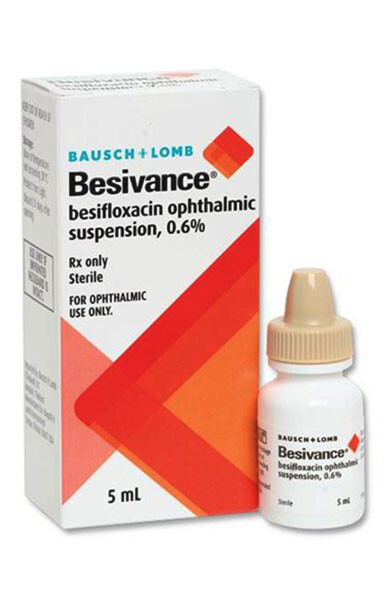
Besivance is an eye medication used to treat certain bacterial eye infections. The drug was originally developed by a Japanese pharmaceutical company, which later sold the rights to InSite Vision Incorporated. InSite Vision improved the original formulation by developing it as eye drops. In 2003, distribution rights were sold to Bausch + Lomb, a company with a strong presence in the Canadian eye-care market and known globally for ophthalmic medications and eye-care products.
Six years later, in 2009, the medication was approved by Health Canada for the treatment of bacterial conjunctivitis.
How Does Besivance Work?
The active ingredient in Besivance eye drops is besifloxacin. This drug belongs to the fourth-generation fluoroquinolone antibiotics. It is effective against Gram-positive, Gram-negative, and anaerobic bacteria. That means Besivance has a broad spectrum of activity and can be used for eye conditions caused by different types of staphylococci, streptococci, and other bacteria that are susceptible to besifloxacin.
It works by blocking bacterial DNA gyrase and topoisomerase IV, enzymes involved in bacterial DNA synthesis and replication. By inhibiting these enzymes, Besivance stops bacteria from growing and leads to their death.
Why Is Besivance Better Than Other Generations of Quinolones?
A major benefit of Besivance is that it was specifically designed for use in the eye. This helps reduce the body's overall exposure to the antibiotic and may help limit the development of resistance, which is an important concern in treating bacterial infections.
What Are Besivance Eye Drops Used For?
Besivance works against a wide range of bacterial infections that cause eye inflammation. It does not work for infections caused by viruses or fungi. That is why it's important to have a medical assessment to identify the cause of the inflammation.
In Canadian clinical practice, Besivance may be used in the treatment and prevention of the following eye conditions:
- bacterial conjunctivitis;
- bacterial inflammation of the cornea;
- bacterial keratitis;
- prevention of eye infection in patients undergoing laser therapy for cataracts;
- prevention of eye infection after eye surgery.
Although bacterial infections can also cause other eye conditions, Besivance should not be used for a stye or blepharitis, as its effectiveness for these conditions has not been shown in clinical studies. In addition, post-marketing reports list blepharitis as a possible side effect of Besivance.
These conditions may require combination treatment with antimicrobial agents and corticosteroids to reduce inflammation while treating the infection. One such combination is Tobradex (tobramycin/dexamethasone). Unlike Besivance, Tobradex is used in the treatment of blepharitis.
What Is Pink Eye? Can Besivance Be Used for Pink Eye?
Pink eye is another name for conjunctivitis. In Canada, it is a common condition that affects people of all ages. Pink eye is inflammation of the conjunctiva, a transparent membrane that covers the whites of the eyes and the inner surface of the eyelids. Because of this inflammation, small blood vessels in the conjunctiva become more visible, making the eyes look pink.
Besivance can help reduce inflammation and clear the bacterial infection when conjunctivitis is caused by bacteria.
Dosage and General Recommendations
Besivance is supplied as an ophthalmic suspension containing 0.6% besifloxacin. This low concentration of the active ingredient allows it to be used topically. A common question is: "Does Besivance contain aspirin?" This is a misconception; acetylsalicylic acid is not among the active or inactive ingredients.
The dosing schedule and length of treatment depend on the organism causing the infection, the reason for use (treatment or prevention), the severity of the condition, and the patient's response.
To treat bacterial conjunctivitis with Besivance, place one drop into the affected eye every 6 to 12 hours. There is no need to treat both eyes if only one is infected. Treatment usually lasts 5-8 days. Symptoms may improve sooner (reported in approximately 70% of cases), but that does not mean treatment should be stopped early. By day 5 of treatment, bacterial eradication may reach about 90%. Stopping early can increase the risk of the infection coming back.
In pediatric patients, the dosage generally does not need to be adjusted.
Because the risk of bacterial resistance to Besivance is considered low, it may be used in patients whose eye infections do not respond to other antibiotics (for example, ciprofloxacin).
How to Use the Drops
A key recommendation is to keep the dropper tip sterile. Each time you open the bottle, be careful not to let the tip touch any surface, including your hands or your eye.
After putting in the drops, try to keep your eye closed for 1-2 minutes with your head tilted back to allow absorption.
Missing a Dose: Is It a Problem?
Try not to miss doses to get the most benefit. If you miss a dose of Besivance, use it as soon as you remember. If it's almost time for your next dose, skip the missed dose.
Who Should Avoid Using Besivance?
Because Besivance is used topically, it has few contraindications. One is eye infections caused by viruses or fungi, since the drug is not active against these organisms.
Besivance should not be used in patients with known hypersensitivity to besifloxacin or other quinolone antibiotics. The product also contains inactive ingredients that may cause allergic reactions in susceptible individuals.
The safety of Besivance in infants younger than 1 year of age has not been established; therefore, it is contraindicated in this age group.
Precautions for Therapy with Besivance
Besivance is available by prescription only, so a doctor's consultation is needed before starting treatment. To reduce the risk of side effects, tell your healthcare provider about all prescription and over-the-counter medications you are taking.
Besivance may cause side effects that can temporarily affect vision, such as blurred vision. Avoid driving or operating machinery until your vision returns to normal.
In pregnancy, Besivance may be used when the potential benefits to the mother outweigh the potential risks to the fetus. This caution is based on animal studies in which besifloxacin caused maternal toxicity.
It is not known whether besifloxacin passes into breast milk. If Besivance is needed during breastfeeding, breastfeeding may need to be stopped, at least for the duration of treatment.
Avoid wearing contact lenses during treatment with Besivance, at least until the signs of infection have cleared. Contact lenses may be inserted at least 15 minutes after using the drops.
Possible Adverse Reactions to Besivance
Topical use generally results in fewer systemic side effects. The incidence of the most common side effects ranges from 1% to 10%. If they occur, they usually affect the treated eye, or both eyes if both are being treated:
- eye redness;
- itching;
- sore eyes;
- blurred vision;
- swelling of the eyelids;
- eye pain;
- headache.
These reactions usually do not require medical treatment, but you should tell your doctor if they occur, persist, or get worse.
Besivance eye drops are not expected to cause side effects involving the cardiovascular system, liver, or kidneys.