Mupirocin is a topical antibiotic used to treat certain bacterial skin infections and, in some cases, to clear nasal carriage of Staphylococcus aureus. It works where it is applied and is usually absorbed only in very small amounts, which helps limit effects elsewhere in the body. To help reduce the risk of resistance, use it exactly as prescribed and for the full recommended length of treatment.
In Canada, mupirocin is regulated and approved by Health Canada.
Side Effects and Precautions
Mupirocin is usually well tolerated, but it can sometimes cause local reactions such as burning, stinging, or itching where it is applied. Some mupirocin products are made with a macrogol base. These products are not suitable for use on mucous membranes and should be used with caution in people with extensive burns or wounds because of the possibility of macrogol toxicity. Extra caution is also needed in people with kidney problems.
How It Works Against Bacteria
Mupirocin is an antibacterial medication that blocks bacterial protein synthesis by binding to isoleucyl transfer RNA synthetase. At low concentrations, it mainly stops bacteria from growing, but at the high concentrations reached with topical use on the skin, it is usually bactericidal. At these concentrations, it may also have some activity against organisms reported to be relatively resistant to mupirocin in vitro. It is mainly active against Gram-positive aerobes.
Most strains of staphylococci, including methicillin-resistant and multiply resistant Staph. aureus, and streptococci are susceptible in vitro, although enterococci are relatively resistant. Mupirocin is also active against Listeria monocytogenes and Erysipelothrix rhusiopathiae. Gram-negative organisms are generally not sensitive, but Haemophilus influenzae, Neisseria spp., and a few others are.
Anaerobic organisms, both Gram-positive and Gram-negative, are generally resistant, and activity against fungi is low. Mupirocin is more active in vitro at acidic pH than under alkaline conditions. Naturally resistant strains of Staph. aureus are rare, but resistance, including high-level plasmid-mediated transferable resistance, has emerged, especially with long-term use. There has been some concern that inappropriate prescribing of mupirocin has led to steadily increasing resistance.
Activity Against Fungi
In in vitro testing, the activity of mupirocin 2% against Candida albicans was comparable to that of other commonly used topical antifungals. Although MICs were considerably higher than those reported for susceptible bacteria, clinical responses in 10 patients suggested that adequate concentrations of mupirocin were reached after topical application.
Pharmacokinetics
Only very small amounts of mupirocin applied to the skin are absorbed into the bloodstream. Once absorbed, it is quickly metabolized to monic acid, which is excreted in the urine.
Uses and Administration
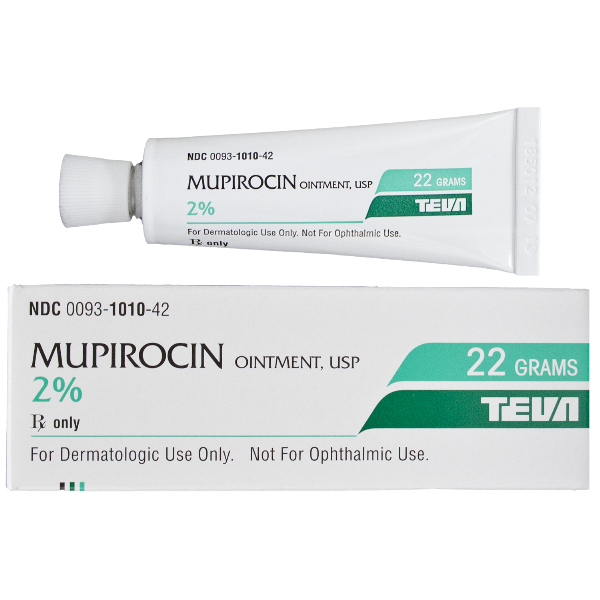
Mupirocin is an antibacterial produced by Pseudomonas fluorescens. It is used topically as a 2% ointment in a macrogol base, or as a cream containing mupirocin calcium equivalent to 2% mupirocin, to treat various bacterial skin infections. In Canadian practice, these preparations should be applied up to 3 times daily for up to 10 days; treatment should be re-evaluated if there is no response after 3 to 5 days.
These preparations are not suitable for use on mucous membranes. For this reason, a nasal ointment containing mupirocin calcium equivalent to 2% mupirocin in a paraffin base is used to clear nasal carriage of Staphylococcus aureus, particularly epidemic methicillin-resistant strains.
The nasal ointment should be applied inside each nostril 2 or 3 times daily for a maximum of 7 days.