Ceftin is a prescription antibiotic used to treat bacterial infections. It may be prescribed on its own or as part of combination therapy. The active ingredient in this medication is cefuroxime axetil. In Canada, it is prescribed based on the type of infection and a clinician's assessment of your other medications, allergies, and medical conditions. It may interact with other medications and medical conditions, cause allergic reactions, and has a long list of possible side effects.

Still, this antibiotic can be useful for treating many types of bacterial infections.
In this article, you'll learn what cefuroxime axetil is used for, where to buy Ceftin online, what forms it comes in, how to store it, what side effects cefuroxime can cause, and more.
What Is Cefuroxime and What Is It Used For?
Cefuroxime (Ceftin) is a second-generation cephalosporin antibiotic. It's used to treat bacterial infections ranging from mild to life-threatening. Your doctor may also prescribe it for uses not listed in the prescribing information.
Conditions treated with Ceftin include:
- Acute bacterial otitis media;
- Pharyngitis/tonsillitis;
- Acute bacterial maxillary sinusitis;
- Impetigo;
- Uncomplicated gonorrhea;
- Uncomplicated urinary tract infections;
- Bacterial infections associated with acute bronchitis;
- Acute bacterial exacerbations of chronic bronchitis;
- Uncomplicated skin and skin structure infections;
- Early Lyme disease.
This medicine can be used to treat all of these conditions in adults and children. However, there are no clear clinical trial data on its use in children younger than 3 months.

It's important to confirm that the infection is caused by bacteria that are susceptible to this medicine. Otherwise, inappropriate use may contribute to the development of antibiotic-resistant bacteria.
What You Should Check Before Taking This Medicine
Talk with your doctor before using this medicine, and let them know about your medical history and any drugs you take, including medicines you start or stop taking, as well as immunizations and vaccinations. It's also important to tell them about any allergies to penicillins, cefuroxime (as axetil or in another form), or other antibiotics.
Do not share this medication with anyone else, even if they have similar symptoms.
Allergic Reaction to Similar Antibiotics
Do not use this medication if you're allergic to:
- Cefdinir (Omnicef);
- Cefprozil (Cefzil);
- Cephalexin (Keflex);
- Cefaclor (Raniclor);
- Cefadroxil (Duricef);
- Cefazolin (Ancef);
- Cefditoren (Spectracef);
- Cefpodoxime (Vantin);
- Ceftibuten (Cedax);
- Cephradine (Velosef).
It's recommended that you ask a pharmacist if you're not sure about the names of medicines you've taken before.
Conditions to Discuss Before Taking Ceftin
To help make sure cefuroxime axetil is appropriate for you, tell your healthcare provider if you have any of the following, or symptoms that could suggest them:
- Penicillin allergy;
- Liver disease (your body may not process the medication properly, which can lead to a buildup);
- Kidney disease (may cause the medication to build up in your body);
- Diabetes (the suspension contains about 3 g of sugar per teaspoon);
- Intestinal problems (including colitis, even if it has resolved);
- Malnutrition;
- Anemia (cefuroxime may rarely cause certain types of anemia; if symptoms occur, contact your doctor right away);
- Phenylketonuria (PKU) (the liquid form may contain phenylalanine);
- Any other bacterial infection (using cefuroxime may allow other organisms to overgrow, which can lead to yeast or other infections).
It's also a good idea to tell your doctor about any other illnesses you've had or allergies you've experienced, even if it happened only once. Tell them if you're pregnant, planning to become pregnant, or breastfeeding, as these factors may affect your cefuroxime dose.
Do not take this drug without a prescription to treat conditions such as the common cold or other non-bacterial infections. Doing so may promote resistant bacteria, which means the medication may not work when you need it in the future.
Medicine Description
Cefuroxime comes in three forms:
- Cefuroxime 250 mg tablets;
- Cefuroxime 500 mg tablets;
- Cefuroxime powder for oral suspension.
Ceftin 500 mg and 250 mg Tablets
The 500 mg tablets are:
- White;
- Capsule-shaped;
- Film-coated;
- Engraved with "GXEG2" on one side.
In addition to 500 mg of cefuroxime, they contain methylparaben, hydrogenated vegetable oil, titanium dioxide, and other ingredients.
The 250 mg tablets are:
- White;
- Capsule-shaped;
- Film-coated;
- Engraved with "GXES7" on one side.
In addition to 250 mg of cefuroxime, they contain methylparaben, hydrogenated vegetable oil, titanium dioxide, and other ingredients.
Ceftin for Oral Suspension
The suspension comes as a dry, granulated powder that is white or pale yellow, with a tutti-frutti flavour. After mixing with water, each 5 mL contains 125 mg of cefuroxime, as well as sucrose, flavouring, xanthan gum, acesulfame potassium, aspartame, stearic acid, and polyvinylpyrrolidone.
Preparation and Administration of Ceftin for Oral Suspension
Prepare the suspension by:
- Shaking the bottle of powder to mix and loosen it;
- Opening the bottle and adding water as directed in the instructions;
- Closing the bottle;
- Turning the bottle upside down, then rocking and shaking it until the water passes through the powder;
- Turning the bottle upright and shaking diagonally until the mixture is uniform.
Shake the mixture before each use and close the bottle tightly afterward. Store it in the refrigerator at 2-8°C (36-46°F). If it is not used within 10 days, discard the mixture and prepare a new suspension when needed.
How to Take Ceftin Tablets
How you take Ceftin depends on the condition being treated. Review the information below and read the medication guide before starting treatment.
Cefuroxime Dosage for Tablets
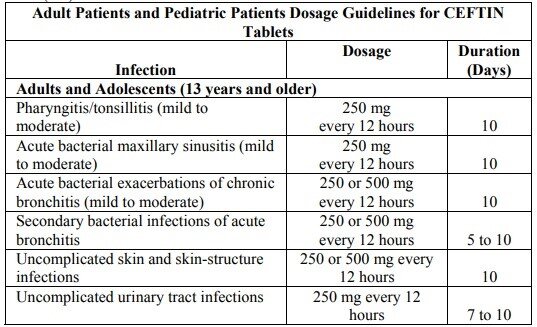 Cr: FDA
The dosages listed here are standard, but your Canadian doctor may adjust your treatment based on your condition, weight, other medical conditions, allergies, other medications, and other factors. Never change your dose without speaking with your doctor. Do not start or stop using Ceftin without a prescription.
Finish the full course of treatment as advised, even if your symptoms start to improve. Completing the full course helps treat the infection properly and lowers the risk of relapse and antibiotic resistance.
Try not to miss doses or take extra medicine to "make up" for a missed dose. If you miss a dose, contact your doctor for advice.
Adult Patients
Adult dosing is generally used for adolescents aged 12 years and older, as well as adults. Typical doses range from:
- 250 mg twice daily;
- to 500 mg twice daily.
The course usually lasts 7 to 10 days, but your doctor may change the length of treatment depending on your specific situation.
For best absorption, take the tablets with meals. Do not crush the tablets; swallow them whole with a full glass of water. If possible, do not split, chew, or crush them.
Pediatric Patients
Pediatric patients are usually prescribed the oral suspension form of Ceftin (see below).
Ceftin Dosage for Oral Suspension
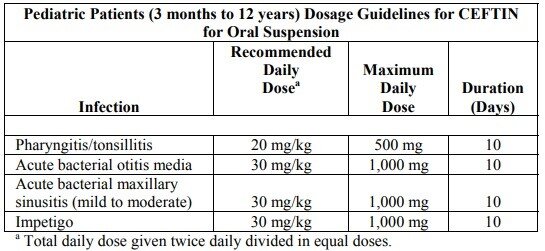 Cr: FDA
Pediatric Patients (3 Months to 12 Years)
Pediatric patients are children younger than 12 years. Dosing depends mainly on body weight:
- 10 mg/kg twice daily;
- 15 mg/kg twice daily.
The course also usually lasts 7 to 10 days, but the doctor may change it. The final dose depends on the condition being treated.
Oral syringes can be used to measure the dose more accurately. You can also use teaspoons, but a syringe is more reliable when precise dosing is needed.
Missing a Dose
If you miss a dose, take it as soon as you remember. However, if it is almost time for your next dose, skip the missed dose. Do not take a double dose to make up for a missed one, as this may cause an overdose.
Ceftin Overdose
If you accidentally take too much Ceftin, call emergency services right away or contact the Poison Help hotline at 1-800-222-1222. If you feel you may have a seizure, ask someone nearby for help.
An overdose may be accompanied by seizures, convulsions, or blackouts.
Cefuroxime Side Effects
Cefuroxime can cause side effects. Some need urgent medical attention, while others can be discussed at your next appointment. Common side effects of Ceftin include:
- Diarrhea;
- Nausea;
- Vomiting;
- Diaper rash in infants;
- Changes in taste.
Tell your doctor if you have any of these side effects. If they do not go away, you may need a change in dose or treatment.
Also keep in mind that the effects listed in the prescribing information are not a complete list. There may be other effects specific to you that you should discuss with your doctor. If you have any unusual problems related to the use of Ceftin, you can also report them to Health Canada.
Requiring Immediate Medical Attention
Side effects that need immediate medical help include:
- Allergic reactions such as trouble breathing, swelling, or hives;
- Severe stomach pain;
- Watery or bloody diarrhea;
- Severe skin rash;
- Easy bruising;
- Numbness;
- Severe tingling;
- Yellowing of the eyes and/or skin;
- Seizure;
- Signs of kidney problems (changes in urination, severe swelling in the feet, fatigue, shortness of breath);
- High fever;
- Burning in the eyes;
- Skin pain, blistering, or peeling.
If symptoms are severe, painful, or getting worse quickly, seek medical attention as soon as possible.
Pregnancy or Breastfeeding Warnings
Tell your doctor if you're pregnant, planning to become pregnant, or breastfeeding. While there are no proven cases of harm to an unborn baby, your doctor may adjust your dose or treatment schedule.
Cefuroxime passes into breast milk and may cause allergic or other reactions in a nursing infant.
Keep in mind that cefuroxime may make hormonal birth control less effective. Talk with your doctor about whether you should use additional contraception.
Cefuroxime is not recommended for children younger than 3 months unless it is clearly needed.
What Will Affect Ceftin: Interactions
Interactions with cefuroxime are common, which is why you should tell your doctor about your diet, medications, and medical conditions. More on that below.
Alcohol/Food Interactions
It's recommended to take Ceftin tablets with meals. Bioavailability increases by almost 20% when a dose is taken with food. However, the bacteriologic response is similar whether the tablets are taken with or without food.
There is not enough information to know whether food improves absorption of the oral suspension.
As for cefuroxime axetil and alcohol, there are no strict warnings that alcohol disrupts absorption, excretion, or effectiveness. However, if you experience side effects such as stomach upset or headache, alcohol may make them worse.
Disease Interactions
This medicine may interact with the following conditions:
- Colitis;
- Renal dysfunction;
- Liver disease;
- Seizure disorders;
- Ferricyanide tests.
Tell your doctor about any of these conditions before starting treatment. They may increase the risk of medication buildup and side effects.
Medicine Interactions
Cefuroxime interactions may include:
- Aminoglycoside antibiotics (amikacin, gentamicin, tobramycin, etc.);
- H2-receptor antagonists (famotidine, ranitidine, etc.);
- Antacids (aluminum hydroxide, calcium carbonate, magnesium hydroxide, etc.);
- Hormonal birth control;
- Bacillus Calmette-Guérin (BCG);
- Disulfiram;
- Sodium picosulfate.
It may also interact with the following vaccines:
- BCG vaccine;
- Cholera vaccine;
- Typhoid vaccine.
Review your prescriptions and tell your doctor if you take any of the medicines listed above before, during, or after a course of Ceftin. Depending on your situation, your doctor may adjust the dose or timing.
Keep in mind that an interaction does not always mean you need to stop taking a medicine. That decision depends on your condition, severity, side effects, and other factors.
The medications listed above are not the only ones that may interact with Ceftin. If you take any other medicines, make sure your doctor knows about them. If you notice any changes in your condition, contact your doctor promptly.
If you drink alcohol or coffee often or smoke cigarettes, mention it during your appointment.
Blood thinners, anti-diarrhea medications, and other drugs may also interact with antibiotics, so do not take them without medical advice.
Storage and Handling
Proper storage and handling matter for this medicine's effectiveness. Here are some general recommendations for storing, handling, and disposing of Ceftin:
- Read the label and prescribing information carefully and follow all directions;
- Do not take the medicine in a larger or smaller amount than prescribed;
- To help reduce stomach upset, do not crush or chew the tablets;
- Shake the suspension well before measuring a dose;
- Keep the suspension refrigerated at 2-8°C (36-46°F);
- Discard the suspension if it is not used within 10 days;
- If you switch dosage forms during treatment, ask your pharmacist about the correct dose;
- Do not stop treatment unless your healthcare provider tells you to;
- Do not use Ceftin to treat viral infections; see a healthcare provider for proper diagnosis and treatment;
- If you are having urine testing, be aware that some tests may be affected;
- Store tablets at room temperature in a cool, dry place;
- Keep the container tightly closed when not in use;
- Do not freeze the suspension;
- Keep all forms of Ceftin out of reach of children and pets;
- Do not dispose of medicines by flushing them or pouring them down a drain unless you have been told to do so.
For disposal recommendations in Canada, ask your pharmacist or follow local guidance. If no take-back program is available, you can mix tablets or suspension with an undesirable substance (for example, cat litter, dirt, or used coffee grounds), place the mixture in a sealed bag or container, and throw it out with your household garbage.