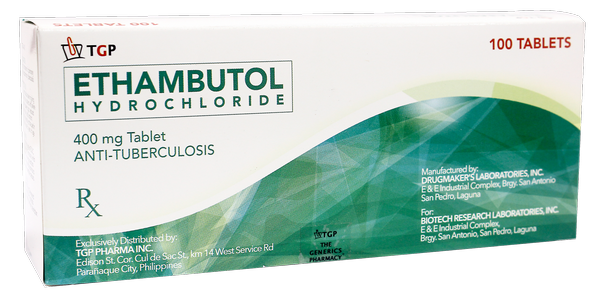
Ethambutol hydrochloride is an antimycobacterial medication used as part of combination therapy. It should not be used on its own to treat active tuberculosis because resistance can develop quickly.
Uses
Tuberculosis
Active Tuberculosis
Ethambutol is used together with other anti-tuberculosis medications to treat clinical tuberculosis.
Mycobacterium avium Complex (MAC) Infections
Off-label notice (Canada): Ethambutol is authorized by Health Canada for pulmonary tuberculosis. Use in MAC (including secondary prophylaxis) is considered off-label and should be guided by an experienced clinician.
Treatment of MAC Infections
Ethambutol is used with other antimycobacterial drugs to treat MAC infections. For disseminated MAC disease in people with HIV, treatment generally includes a macrolide plus ethambutol 15 mg/kg orally once daily, with rifabutin added in some cases depending on the clinical situation, disease severity, and the potential for drug interactions. Guidance also notes that, because antiretroviral therapy is usually given at the same time, a regimen that minimizes drug-drug interactions is preferred.
Prevention of Recurrence
To help prevent recurrence of disseminated MAC infection (secondary prophylaxis), some guidelines recommend maintenance therapy after initial treatment is completed. Stopping treatment may be considered in selected patients who have sustained immune recovery (for example, CD4+ T-cell counts >100 cells/mm^3 for at least 6 months on effective antiretroviral therapy) and remain asymptomatic, based on specialist guidance.
Administration
Ethambutol hydrochloride is taken by mouth.
Dosage
Active Tuberculosis
When treating clinical tuberculosis, ethambutol should not be used alone. The manufacturer states that the usual adult dose, used with other anti-tuberculosis medications in previously untreated patients, is 15 mg/kg once daily. In adults who have had previous anti-tuberculosis treatment, the usual dose recommended by the manufacturer is 25 mg/kg daily for 60 days, followed by 15 mg/kg daily.
Canadian clinical summaries that use weight-based dosing tables generally list the following for daily therapy in adults and children 15 years of age or older: 800 mg (40-55 kg), 1.2 g (56-75 kg), and 1.6 g (76-90 kg). If a 3-times-weekly regimen is used, the listed doses are 1.2 g (40-55 kg), 2 g (56-75 kg), and 2.4 g (76-90 kg) (maximum 2.4 g). If a twice-weekly regimen is used, the listed doses are 2 g (40-55 kg), 2.8 g (56-75 kg), and 4 g (76-90 kg) (maximum 4 g). Intermittent regimens should only be used under expert guidance.
Pediatric Dosage
The manufacturer states that ethambutol hydrochloride is not recommended for children younger than 13 years of age. Some TB guidance uses ethambutol in children when needed; typical dosing in guidelines includes 15-20 mg/kg daily (maximum 2.5 g) or 50 mg/kg twice weekly (maximum 2.5 g), with caution when visual acuity is difficult to monitor.
Dosage in Renal Impairment
In patients with impaired kidney function, the dose and/or dosing frequency of ethambutol hydrochloride should be adjusted based on the degree of renal impairment. Ethambutol may build up in renal insufficiency; a lower dose is recommended, and monitoring for eye toxicity is especially important.
Precautions and Contraindications
Ethambutol is generally contraindicated in patients with optic neuritis unless clinical judgment determines that it may be used. It should be used with great care in patients with visual defects, older adults, and patients in whom it may be difficult to assess changes in visual acuity.
Patients should be advised to report visual disturbances right away and to stop taking ethambutol until they have had a visual assessment. Ethambutol should be given at a lower dose to patients with renal impairment. Ethambutol may trigger gout attacks.
Ocular monitoring
Visual acuity should be tested before starting ethambutol and periodically during treatment, and monthly when a patient is taking more than 15 mg/kg/day.
Pregnancy
Ethambutol has caused teratogenic effects in animals when used at high doses. Canadian product information advises using it during pregnancy only when the expected benefit justifies the potential risk to the fetus.
Breastfeeding
Ethambutol passes into breast milk. Canadian product information states that it should only be used if the expected benefit to the mother outweighs the potential risk to the infant.
Children
Canadian product information: ethambutol is not recommended for pediatric patients under 13 years of age because safe conditions for use have not been established, and it is contraindicated in patients who are unable to recognize and report visual side effects or changes in vision. Some tuberculosis guidelines use ethambutol in younger children when needed, but monitoring for visual toxicity can be difficult; dosing and monitoring should be guided by an experienced clinician.
Possible Side Effects
Ocular effects
The most important side effect of ethambutol is retrobulbar neuritis (optic neuropathy), which can cause reduced visual acuity, narrowing of the visual field, central or peripheral scotoma, and loss of red-green colour discrimination. One or both eyes may be affected. The degree of visual impairment appears to depend on the dose and length of treatment; toxicity is seen most often at daily doses of 25 mg/kg or more and after at least 2 months of therapy.
The risk of ethambutol-associated optic neuropathy increases with higher doses and longer treatment, and in rare cases it may happen after only a few doses (possibly due to an idiosyncratic reaction). When eye toxicity is found early and ethambutol is stopped promptly, the visual effects are generally reversible over weeks to months; rarely, recovery may be delayed for up to 1 year or longer, or the effect may be irreversible.
Other adverse effects
Other reported side effects include confusion, disorientation, hallucinations, headache, dizziness, malaise, jaundice or temporary liver dysfunction, peripheral neuropathy, thrombocytopenia, pulmonary infiltrates, eosinophilia, and gastrointestinal symptoms such as nausea, vomiting, loss of appetite, and abdominal pain. Hypersensitivity reactions including skin rash, itching, leucopenia, fever, and joint pain have occurred, but they appear to be rare with ethambutol. Increased serum uric acid concentrations and acute gout have occurred occasionally.
Drug Interactions
Taking ethambutol with antacids containing aluminum hydroxide may reduce absorption. It is recommended to avoid taking them together for at least 4 hours after taking ethambutol.
Pharmacokinetics
After a single oral dose of 25 mg/kg, peak serum ethambutol concentrations of about 2 to 5 mcg/mL appear within 2 to 4 hours. Serum levels generally fall to undetectable levels by 24 hours after the last dose, except in some patients with abnormal kidney function. Approximately 50% of a dose is excreted unchanged in the urine within 24 hours, and an additional 8 to 15% appears as metabolites; about 20 to 22% of the initial dose is excreted in the feces as unchanged drug. Ethambutol may accumulate in patients with renal insufficiency.
Mechanism of Action
Ethambutol is bacteriostatic. The drug appears to inhibit the synthesis of one or more metabolites in susceptible mycobacteria, causing impaired cell metabolism, arrest of multiplication, and cell death.
Storage
Ethambutol hydrochloride tablets should be protected from light and moisture and stored in well-closed containers at 20-25°C (68-77°F); excursions permitted to 15-30°C (59-86°F).